From contemporary and premium cruising to ultra-luxury, river and polar expedition products, conversations at Arabian Travel Market pointed to a Middle East cruise market becoming more diverse, while travel advisor education, product differentiation and sustained regional engagement remain central to converting interest into bookings.
DUBAI, 19 September 2026: Arabian Travel Market 2026 concluded in Dubai after four days of meetings, partnerships and industry discussions bringing together regional and international travel stakeholders at Dubai World Trade Centre.
The 33rd edition attracted travel buyers representing more than 115 countries, with more than 55 destination stands alongside tourism authorities, airlines, transport providers, hospitality companies, technology businesses and other travel-sector organisations. The event’s official wrap-up described ATM as a platform for strengthening partnerships, sharing industry insights and identifying new areas for collaboration.
Cruise had a notably broad presence across ATM 2026, spanning contemporary, premium, luxury, river, yacht-style and expedition products.
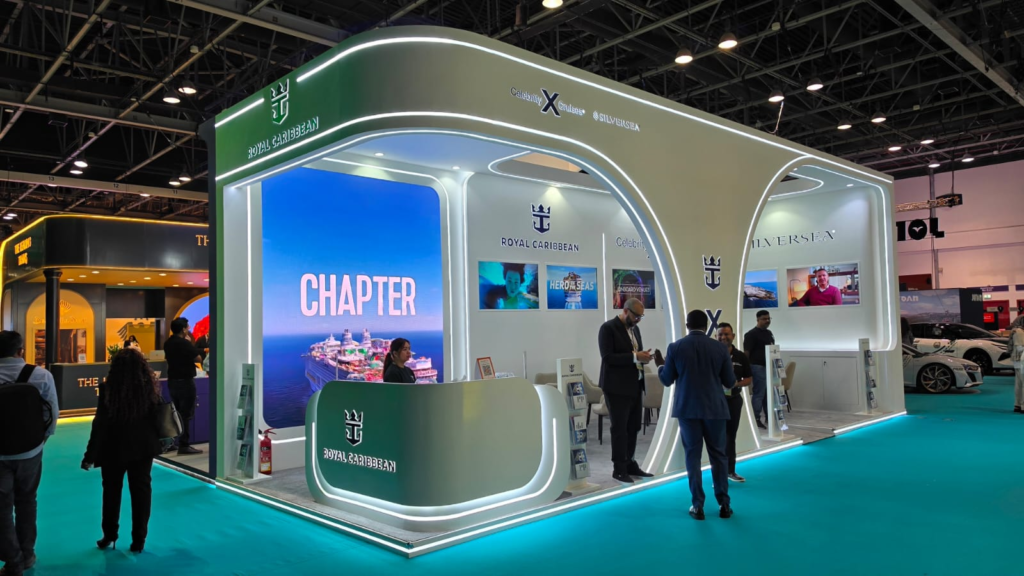
Brands represented across the show included Royal Caribbean, Celebrity Cruises, Silversea, MSC Cruises, Explora Journeys, Norwegian Cruise Line, Cunard, Princess Cruises, Oceania Cruises, Regent Seven Seas Cruises, Crystal, Scenic Luxury Cruises & Tours, Emerald Cruises & Tours, Swan Hellenic, Quark Expeditions, HX Expeditions, Polar Latitudes Expeditions, Oceanwide Expeditions, Four Seasons Yachts and Orient Express Sailing Yachts. Royal Caribbean Arabia’s ATM presence represented Royal Caribbean, Celebrity Cruises and Silversea, while Crystal was represented through Abercrombie & Kent MICE.
Regional cruise specialists also provided platforms through which international brands engaged with Middle East travel partners. CruiseXplore‘s ATM portfolio included Emerald Cruises & Tours, Holland America Line, Hurtigruten Cruises, Norwegian Cruise Line, Polar Latitudes Expeditions, Quark Expeditions, Scenic Luxury Cruises & Tours, and Seabourn. Cruise Master Middle East brought together Princess Cruises, Cunard, Norwegian Cruise Line, Oceania Cruises, Regent Seven Seas Cruises, HX Expeditions and Swan Hellenic.
Against this backdrop, The Cruise News Middle East (TCN) spoke with representatives from Royal Caribbean Arabia, Crystal Cruises, Oceania Cruises, Regent Seven Seas Cruises, Scenic Group, Quark Expeditions and Swan Hellenic to understand what they were hearing from regional travel partners, how customer interests are evolving, what advisors need to sell cruise more effectively and where the opportunity could develop next.
Cruise demand becomes more segmented
One theme emerging across the conversations was that cruise in the Middle East can no longer be treated as a single product proposition.
Mohamed Saeed, Managing Director of Royal Caribbean Arabia, said the GCC was becoming more sophisticated in the way travellers approach cruise. Alongside multigenerational family holidays, the company is seeing interest in adventure, destination-led travel, smaller ships and colder-climate itineraries, including the Arctic, Antarctica and Galápagos. That range is reflected within Royal Caribbean Arabia’s own portfolio. Royal Caribbean addresses family and multigenerational travel, Celebrity Cruises offers a different premium proposition, while Silversea extends into luxury and expedition cruising. At ATM, Saeed highlighted growing interest from affluent Middle East travellers in smaller ships and experience-driven travel.
A similar emphasis on product matching emerged from Crystal. Matthew Boutwell, Senior Director, Charter & Incentives at Crystal, said advisors need to understand both the traveller and the proposition they are recommending because “one brand does not fit all.” He argued that product understanding becomes particularly important when selling a service-led luxury experience rather than relying primarily on brand visibility.
Oceania Cruises and Regent Seven Seas Cruises similarly presented two distinct propositions to the trade. Roberto Cabello, Business Development Manager for Southern & Eastern Europe and Middle East, described Oceania as centred strongly on gastronomy and longer itineraries, while Regent Seven Seas Cruises similarly presented two distinct propositions to the trade.
The common thread was not that one type of cruise is replacing another. Rather, Middle East travel advisors increasingly need to understand which cruise proposition suits which traveller.
Agent education emerges as the common requirement
Across almost every interview, education was identified as one of the most important requirements for further cruise growth in the region.
For Royal Caribbean Arabia, the response combines training with technology. Saeed said cruise bookings can be more structurally complex than conventional hotel reservations, particularly for GCC families booking multiple cabins. The company’s B2B platform is designed to make that process easier for trade partners, while webinars and face-to-face training help advisors understand segmentation across different cruise products.
Cabello said Oceania Cruises and Regent Seven Seas Cruises need to continue building awareness of luxury cruise among regional advisors. His view was that agents become more confident once they understand what is included and how the product differs from larger mainstream lines. Events, training and particularly ship visits can help make those distinctions tangible. Oceania Vista’s expected Dubai calls in 2027 could provide another opportunity for regional trade partners to experience the product directly.
Achim Weber, Head of Sales DACH, Middle East and Africa for Scenic Group identified a similar challenge for Scenic Luxury Cruises & Tours and Emerald Cruises & Tours. The company has invested in training in the UAE since rebuilding its regional activity following the pandemic. Weber said smaller yachts and river products require explanation because many advisors are more familiar with larger cruise ships already visible in the region. Webinars, marketing materials, social content and FAM trips are among the tools being used to improve travel agent understanding of the cruise offering.
Swan Hellenic‘s message was particularly direct. “Education, education, education is number one,” the company’s Mutaz Mokhtar, Head of MENA, told TCN. He identified webinars, workshops, roadshows and FAM trips as priorities, while also stressing the importance of teaching advisors how expedition itineraries differ from conventional cruises, including seasonality, routing and the more dynamic nature of expedition programmes.
Taken together, the interviews suggest that the challenge for the regional trade is moving beyond simply knowing that cruise exists towards understanding a widening range of cruise categories well enough to recommend them with confidence.
Experience-led products require a different conversation
The requirement for education becomes even more apparent when the product is less familiar. For Quark Expeditions, polar cruising remains relatively niche in the Middle East, but Becky Francis, Director of Sales, EMEA said ATM conversations revealed strong curiosity among agents. She described advisors looking for new destinations and products for well-travelled, high-net-worth clients who may already have experienced conventional cruising, luxury holidays or superyachts but have never considered Antarctica or the Arctic. For Quark, that means explaining the destination first and then demonstrating what expedition travel can involve.
Quark plans to support that awareness with further investment in influencer partnerships, agent education, ship visits, FAM opportunities, PR and trade communications.
“We are massively going to invest time, resource and energy into this market over the next 12 months for sure,” Francis said during the interview.
Swan Hellenic is approaching the same awareness gap through a combination of trade and consumer education, while Scenic Group sees an increasing emphasis on experiences among affluent customers.
Weber told TCN that for wealthy travellers, the proposition increasingly goes beyond conventional definitions of luxury towards the experiences offered by the ship and destination. For Scenic Group, that includes smaller vessels, local immersion and destination-led gastronomy.
These conversations reinforce another distinction emerging from ATM: as the range of cruise products available to Middle East travellers expands, selling cruise increasingly requires advisors to explain the experience, not simply the ship or itinerary.
From awareness to conversion
The interviews also highlighted the importance of sustained regional market development rather than one-off visibility.
Boutwell described the GCC as “an incredibly important source market” for Crystal, pointing to family-group travel, international mobility and an appetite for exploring different parts of the world. His broader point was that recognition in markets such as the GCC requires consistent investment and clear messaging over time.
For Quark Expeditions, planned influencer and trade activity is intended to create both consumer awareness and greater advisor confidence. The company also sees longer-term potential in groups, multigenerational travel, charters and even MICE applications for polar voyages.
Scenic Group is continuing its trade-training programme, while Swan Hellenic plans further workshops, roadshows and FAM activity. Oceania and Regent see future ship visits as a particularly effective way to turn product familiarity into confidence at point of sale.
Royal Caribbean Arabia, meanwhile, described ATM itself as increasingly centred on maintaining relationships, refreshing engagement with existing trade partners and making new connections, with much of the resulting commercial activity taking place after the show.
That observation is particularly relevant to the wider cruise presence at ATM 2026. For international cruise brands, the four-day event offered more than product visibility. It provided direct access to the regional distribution partners that remain critical to building awareness, explaining increasingly specialised products and converting interest into bookings.
A broader cruise opportunity
ATM 2026 did not point to a single Middle East cruise customer. Instead, the conversations reflected a market spanning multigenerational families, experienced premium travellers, ultra-luxury guests and affluent customers seeking increasingly specialised experiences, including river and polar expedition travel.
Nor did the interviews suggest that awareness alone will unlock that opportunity. Across companies serving very different parts of the cruise sector, the recurring priorities were remarkably consistent: stronger product education, closer trade engagement, first-hand product experience, effective regional representation and sustained investment in the market.
For Middle East travel advisors, this means the cruise sales conversation is becoming more nuanced. The opportunity is increasingly about understanding not only whether a customer wants to cruise, but which type of cruise, which experience and which brand best fits that traveller.
For cruise lines, ATM 2026 reinforced the role of the regional trade in making that match.
And as those relationships develop beyond the exhibition floor, the next stage of Middle East cruise growth may depend as much on how effectively the industry equips its sellers as on how many new products it brings to market.
Source: Official The Cruise News (TCN) Interviews with stated Cruise Lines at the Arabian Travel Market, 2026, Dubai World Trade Centre, Dubai