Europe’s low-water season has prompted river cruise operators to alter itineraries, use ship swaps and land transfers and, in some cases, cancel departures. Rain brought temporary relief to parts of the Rhine in late August, but water levels have since fallen sharply again. The deeper test is how much disruption the river-cruise model can absorb while still delivering the holiday guests were sold.
Industry Analysis | Updated 9 September 2026
Europe’s 2026 low-water season has entered a more volatile phase rather than following a continuous downward trajectory. Rainfall brought temporary improvement to some sections of the Rhine in late August, but levels subsequently fell again, while exceptionally low readings persisted on parts of the Danube. Operators have consequently continued to assess individual departures and apply different combinations of fleet, itinerary and land-based contingency measures.
On the Rhine, rainfall brought short-lived relief after record lows earlier in August. Reuters reported that the Kaub gauge, one of the Middle Rhine’s critical navigation points, had risen to around 72cm by 31 August, compared with 60cm on the preceding Friday. Official data from Germany’s Federal Waterways and Shipping Administration, WSV, recorded the Kaub gauge at 26cm at 07:00 on 9 September.
Conditions on the Danube also remained severe in places. The official Danube FIS Portal recorded the Budapest gauge at 3cm at 06:00 on 9 September.
Those readings require an important qualification. A gauge reading is not the depth of water available beneath a vessel; it measures water level relative to a fixed reference point. On the Rhine, the Central Commission for the Navigation of the Rhine, or CCNR, states that, unlike high water, there is no single low-water threshold beyond which navigation is prohibited. Each vessel’s skipper must determine whether a particular section can be navigated safely. The operational effect therefore varies according to river section, available channel, vessel draught, loading and design.
Freight and passenger impacts consequently do not necessarily move in lockstep. Low water can force heavily laden cargo vessels to reduce loads or suspend movements before another vessel reaches its own navigational limit. Severe freight disruption remains a useful indication of river conditions, but it should not automatically be interpreted as evidence that every passenger vessel on the same waterway must stop sailing.
At sufficiently extreme levels, however, passenger shipping can also be affected. Germany’s Federal Association of Inland Shipping warned in early August that forecast conditions at Kaub could make commercial, day-trip and cruise traffic unable to pass the section.
The current episode follows months of hydrological pressure. Copernicus reported that July river flows were much below average across large parts of western, central and eastern Europe. Exceptionally low-flow conditions affected the Rhine, where July discharge in Germany and the Netherlands fell to the lowest level on record for that month, and the Danube, where record or near-record low water disrupted navigation across several countries.
By mid-August, the European Drought Observatory said drought conditions remained stable and critical across most of Europe, with alert conditions persisting in southern Germany and throughout much of the Danube Basin. A separate Joint Research Centre assessment said drought had deteriorated through July and August, pushing the Rhine and Danube, alongside the Loire and Po, to record-low levels during August.
On the Danube, the operational effects had already become visible by mid-July. Reuters reported on 16 July that water in Budapest had fallen to within eight centimetres of the previous record low, leaving several cruise vessels stranded or waiting in ports. Avalon Waterways confirmed at the time that it had cancelled a small number of Danube and Rhine departures.
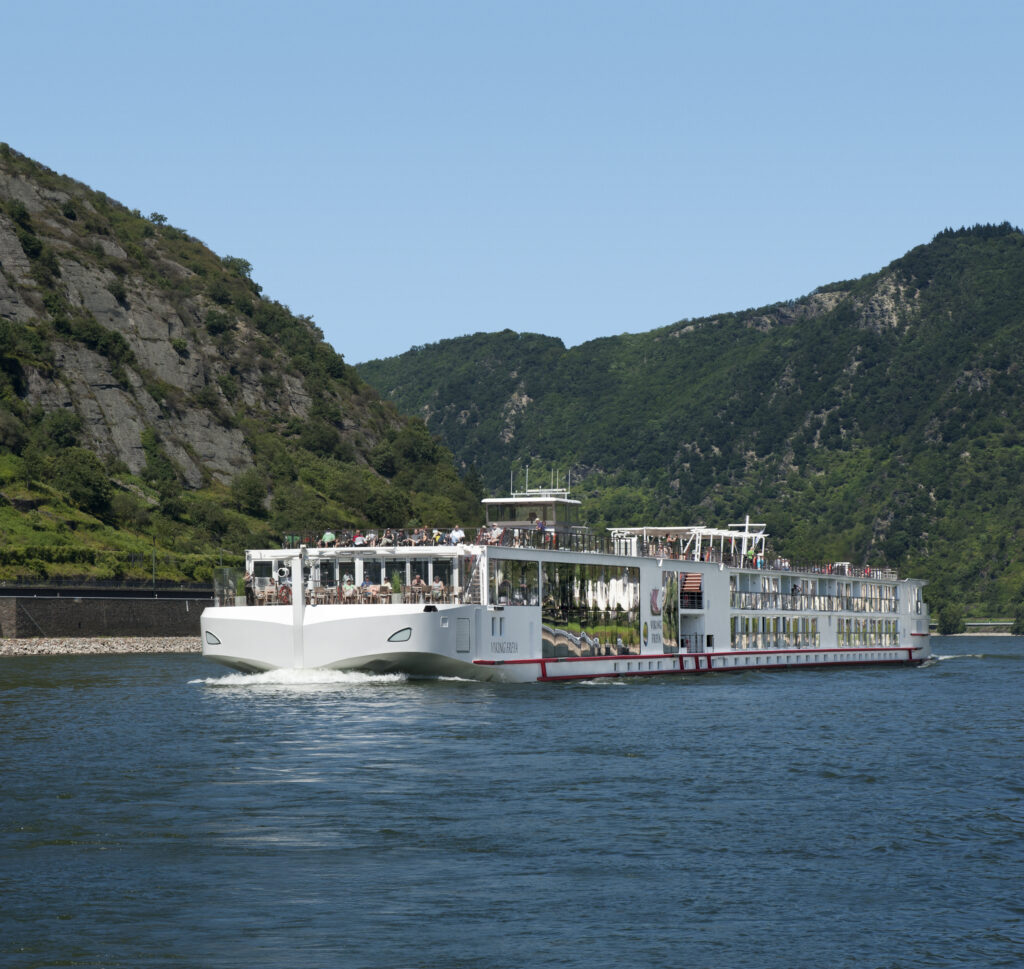
On 28 July, Viking Ullur ran aground on the Danube approximately 25 kilometres upstream from Vidin during low-water conditions. Bulgarian authorities said 186 passengers and 52 crew were aboard, with all passengers subsequently evacuated.
The episode can usefully be viewed through three different forms of resilience. Navigational resilience asks whether a vessel can safely pass a particular river section. Operational resilience asks whether an operator can reposition ships, guests, crew, coaches and excursions quickly enough to keep the journey functioning. Product resilience asks a harder commercial question: whether the modified holiday still resembles the river cruise the guest purchased.
A multi-operator, multi-river challenge
The impact remains uneven, but the number of operators making adjustments shows that the issue extends beyond any single cruise line.
Viking issued a new public advisory dated 1 September covering the Danube, Elbe and Rhine. It said recent rainfall had “significantly improved” conditions in some areas, although water remained below normal on certain sections and selected itineraries could still require modification. Affected guests and travel advisors are being contacted ahead of departure where changes are expected. The operator points to the scale and structure of its European fleet as part of its contingency response. Viking owns and operates what it describes as the industry’s largest river fleet, controls more than 100 docking locations and deploys identical sister ships on the same itinerary in opposite directions. In certain water-level situations, guests and luggage can be transferred around an affected section to the corresponding stateroom on an identical sister ship.
That fleet strategy has now been tested on a significant scale. During Viking’s August earnings call, management said that, as of mid-August, more than 50% of its third-quarter River capacity passenger cruise days, or PCDs, had been affected by low-water conditions. Management clarified that its reported 10% to 12% cancellation metric applied to that affected 50% of River capacity PCDs. Viking also began issuing future-cruise vouchers to certain affected guests in response to the disruption. Viking separately said it had continued operating many affected itineraries through operational workarounds rather than cancelling affected sailings outright. The 10% to 12% PCD cancellation metric should therefore not be read as meaning that 10% to 12% of Viking departures were cancelled.
The company said the low-water episode began in July and therefore did not affect the second-quarter financial results it reported. Management expected the direct impact to fall principally in the third quarter through additional transport and operating costs, while voucher redemptions would affect later periods. At the same time, Viking reported continued forward demand. As of 9 August, 42% of its 2027 River capacity was sold, while 53% of capacity across its wider Core Products portfolio had been sold. Viking said it had not observed a specific deterioration in River booking cadence attributable to the low-water conditions at that point.
For the sector, this suggests a useful distinction between operational pressure and demand resilience. The episode has produced measurable disruption, additional costs and compensation within Viking’s river business without yet demonstrating a corresponding structural retreat in forward demand.
AmaWaterways’ current advisory says evolving conditions on sections of the Rhine and Danube may require selected changes to ports, embarkation or disembarkation locations, motorcoach transfers, ship scheduling or other itinerary elements, with affected guests contacted individually.
Travelmarvel similarly says unusually low water on parts of the Rhine and Danube is affecting navigation in some areas. Its operations and nautical teams continue to monitor conditions, with guests generally contacted approximately one week before departure about potential impacts to their specific itinerary.
A-ROSA illustrates how operating outcomes can differ between operators. The company said all of its ships had returned to service from 4 September after water levels on the Rhine and Danube rose. It nevertheless continued to warn that individual itineraries could require route, embarkation, disembarkation or excursion changes. On the Danube, its 2 September update said regular embarkation in Passau was possible and vessels could sail as far as Vienna, with excursions and complimentary transfers used to reach Bratislava and Budapest.
Riviera Travel has taken a different commercial approach. By the end of August, it had temporarily paused new sales of Rhine and Danube cruises scheduled through 13 September because of continued uncertainty. Existing sailings were not automatically cancelled. As reported by Travel Weekly, Riviera said it would not replace significant sections of a planned river journey with repeated, long-distance coach journeys merely to keep an itinerary running.
The episode illustrates why the relevant industry question is not simply whether “the Rhine” or “the Danube” is navigable. It is also how much flexibility an individual operator has when a particular section is not. Fleet positioning, access to alternative vessels, docking relationships, ground-transport capacity and the speed of guest communication can all influence the outcome of the same hydrological event.
What operators are doing
Ship swaps, altered ports, coach transfers and revised sailing schedules have formed the core of the operational response. Viking’s sister-ship strategy allows it in certain circumstances to move guests around an unnavigable stretch while preserving the corresponding cabin and onboard environment. AmaWaterways and Travelmarvel are using or preparing selected itinerary modifications, while Riviera has shown that another option is temporarily to stop selling a product where the eventual experience cannot be predicted with sufficient confidence. A-ROSA’s return to service, meanwhile, demonstrates that improving water conditions can restore wider operations even while individual route adjustments remain necessary.
For the sector, this points to the value of operational redundancy. Access to another vessel, docking point, coach network or alternative itinerary can give an operator more ways to preserve a journey when a particular river section cannot be sailed as planned.
Viking’s use of identical sister ships is especially relevant to the distinction between operational and product resilience. Where guests can move into the corresponding stateroom on an identical vessel, the workaround can preserve more of the onboard product than a solution that replaces large parts of the voyage with land transport.
When keeping the itinerary moving is not enough
The ability to move guests around a navigational obstruction does not necessarily preserve every element of the original holiday.
The degree of substitution matters. Moving guests between identical sister ships can preserve accommodation and much of the onboard environment. A workaround that replaces substantial stretches of river sailing with repeated road transfers or hotel stays can change the format of the journey more significantly.
Viewed commercially, this creates a distinction between operational continuity and product integrity. An operator can successfully transport a guest from one destination to another while still changing the character of the experience originally purchased. River cruising is sold partly on the proposition of travelling between destinations by water, unpacking once and watching the landscape move past the ship.
Viking’s voucher response and Riviera’s temporary stop-sale make that question less theoretical. Viking issued future-cruise vouchers to certain affected guests following disruption, while Riviera chose temporarily not to accept new bookings on affected Rhine and Danube dates while uncertainty remained.
The implication for river-cruise operators is that communication becomes another component of resilience alongside fleet and logistics. The relevant question may not only be whether an itinerary can technically continue, but how much of the original product can still be delivered and how clearly that difference is communicated before departure.
From seasonal disruption to strategic planning
Low water is not new to European river cruising. What makes 2026 strategically relevant is the wider evidence around hydrological variability.
The European Environment Agency says droughts have increased in frequency and severity over the past decade, affecting seasonal water availability. It expects climate change to intensify seasonal fluctuations in freshwater availability and further increase the frequency, intensity and impact of drought events.
A significant policy-level development came on 12 August, when representatives of the Danube Commission’s member states issued a public statement expressing serious concern about increasingly frequent periods of extreme water levels and their consequences for navigation and the wider Danube region.
The statement called for stronger cooperation on monitoring, forecasting and data exchange; better coordinated management of low-water periods; investment in resilient transport infrastructure and information systems; stronger climate-impact research; and a common approach to risk management. It argued that adaptation to low water and other extreme hydrological events should become a common strategic priority for the Danube region.
That matters because the issue is no longer being framed solely as an operational problem for individual ships or cruise lines. The Danube Commission is treating navigational resilience as a cross-border infrastructure, information and risk-management challenge affecting the wider river corridor.
The Rhine is undergoing similar longer-term assessment. Preliminary projections cited by the CCNR indicate that seven-day low flows at Kaub could decline by between 10% and 30% by 2100 across the scenarios considered. The CCNR stresses that those projections remain preliminary and says firm conclusions about infrastructure adaptation cannot yet be drawn.
Those projections should not be interpreted as evidence that European river cruises will routinely become cancellable. They do, however, suggest that water-level variability may need to be treated increasingly as a strategic operating condition rather than solely as an occasional summer exception.
Low water is also only one side of that variability. The CCNR notes that high water operates differently: above specified levels, navigation can be halted on affected Rhine sections, while low-water decisions remain vessel- and section-specific.
The more relevant question may therefore be hydrological variability rather than drought alone. For river cruising, resilience can mean being able to function across a wider range of river conditions rather than planning solely around a single type of water-level disruption.
A new measure of reliability
The evidence does not point to a system-wide shutdown of European river cruising. Viking continues to describe impacts on selected itineraries; A-ROSA returned all of its ships to service from 4 September; and other operators continue to review individual departures. At the same time, exceptionally low readings at Kaub and Budapest on 9 September show that the underlying hydrological constraint remains live on important river sections.
What has changed since the height of the August disruption is the evidence that short-term improvement does not necessarily amount to resolution. The Kaub gauge rose to around 72cm following late-August rainfall before dropping back below 30cm in early September. Viking’s 1 September advisory reflects that uncertainty: conditions had improved significantly in some locations, but water remained below normal elsewhere and selected itinerary changes could still be required.
This points to a second distinction emerging from the season: exposure to the same natural constraint does not mean operators have the same capacity to respond to it. Fleet flexibility, duplicated ship classes, docking access, ground logistics, forecasting and transparent communication may increasingly form part of the competitive value of the river-cruise product itself.
There may also be another factor: how an operator defines the point at which an altered itinerary no longer delivers enough of the original river-cruise proposition. Viking’s compensation response and Riviera’s temporary stop-sale represent different commercial responses to that underlying challenge.
One difficult season does not establish that demand for European river cruising is structurally weakening. Viking’s 2027 River booking position suggests that, within its business at least, forward demand remained robust while the low-water disruption unfolded. What the 2026 season is revealing more clearly is that operational continuity and preservation of the purchased product are not always the same thing.
The strategic test may therefore be less about whether operators can eliminate water-level disruption, something they cannot control, and more about how much disruption the product can absorb before the holiday being delivered becomes materially different from the holiday that was sold.
That may ultimately be the most important measure of river-cruise resilience.
Sources & References
Primary / Institutional Sources
- Viking River Cruises — Updates on Current Sailings: Danube, Elbe & Rhine Rivers, 1 September 2026. Viking current-sailings advisory
- Viking Holdings — Second Quarter 2026 Financial Results, 19 August 2026. Viking Q2 2026 results
- Viking Holdings / SEC filing — Q2 2026 filing with River and Core Products booking data, including 42% of 2027 River capacity sold as of 9 August. Viking Q2 SEC filing
- AmaWaterways — Travel Updates and Advisories: Rhine & Danube River Updates, updated 3 August 2026. AmaWaterways travel advisory
- Travelmarvel — Europe Low Water Levels, travel advisory. Travelmarvel travel update
- A-ROSA — Current Travel Information: Rhine and Danube, including the return of all ships from 4 September and Danube operating adjustments. A-ROSA current travel information
- Federal Waterways and Shipping Administration, Germany (WSV) / PEGELONLINE — Official Kaub gauge observations — Accessed 9 September 2026. PEGELONLINE official gauge data
- Danube FIS Portal — official Budapest and Danube gauge information. Accessed 9 September 2026. Danube FIS water-level data
- Central Commission for the Navigation of the Rhine (CCNR) — information on Rhine waterway availability, including high- and low-water navigation rules. CCNR Rhine waterway information
- Danube Commission — Public Statement of the Representatives of the Member States of the Danube Commission, 12 August 2026. Danube Commission statement
- Copernicus Climate Change Service — Precipitation, Relative Humidity, Soil Moisture and River Flow for July 2026. Copernicus July hydrology bulletin
- European Commission Joint Research Centre / European Drought Observatory — Worsening Drought and Record Heat Grip Europe, 12 August 2026, and mid-August drought assessment. JRC August drought assessment
- European Environment Agency — Water Scarcity Conditions in Europe, including longer-term drought and freshwater-availability trends. EEA water-scarcity indicator
Independent Reporting & Industry Sources
- Bulgarian News Agency (BTA) — official-authority reporting on the Viking Ullur grounding and evacuation near Vidin, 28 July 2026. BTA Viking Ullur report
- Reuters — Rhine Water Rises After Rain, Shipping Problems Not Yet Over, 31 August 2026. Reuters Rhine update
- Reuters — Near-record Low Water Levels Disrupt Tourism on Danube, 16 July 2026. Reuters Danube report
- Travel Weekly — Riviera Pauses Danube and Rhine River Cruise Sales, 31 August 2026. Travel Weekly Riviera report
- Travel Weekly — Low Water, High Stakes: River Lines Take a Hit to Satisfy Guests, 20 August 2026. Travel Weekly industry impact report
- Seatrade Cruise News — Half of Viking’s Q3 River Cruises Impacted by Low Water So Far, 19 August 2026. Used as industry corroboration of Viking’s earnings commentary. Seatrade Cruise News Viking report