GENEVA, 31 August 2026: An MSC Foundation-supported global assessment of coral reefs has found an approximately 9.5% relative decline in average hard coral cover compared with the 1980–2009 baseline. The assessment also finds that reefs can recover in several regions when local pressures are managed effectively.
The Status of Coral Reefs of the World: 2025 report was produced by the Global Coral Reef Monitoring Network and draws on 40 years of data. It brings together 21.1 million observations from 36,886 reef sites, more than ten times the number included in the 2020 assessment.
Global Hard Coral Cover Declines by 9.5%
The report identifies mass bleaching events driven by marine heatwaves as a major factor in the decline in coral cover. As these events become more frequent and intense as the climate warms, reefs have less time to recover between disturbances. At the same time, the assessment finds that reefs can recover in several regions when local threats are managed effectively. These include overfishing, coastal development, water pollution, run-off and coral predation. The release says well-designed local action can strengthen reef resilience and improve the prospects for recovery following bleaching.
Dr. Manuel González Rivero, lead author of the report, said: “This report provides the most comprehensive assessment to date of the status of the world’s coral reefs, and the message is clear: Governments must act with urgency to implement evidence-based policy and management. The strongest pathway to safeguard coral reefs is rapid emissions reductions, effective action on local pressures and sustained long-term monitoring so action is targeted where it matters most.”
MSC Foundation Supports Research and Restoration
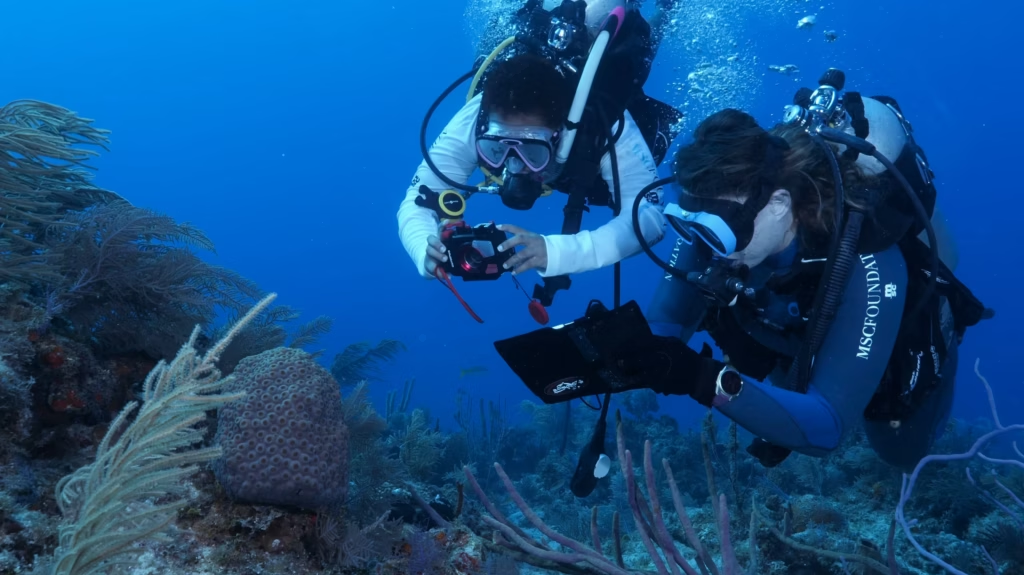
The MSC Foundation contributed funding alongside other donors to the latest GCRMN report and provided a case study covering its Super Coral Reefs Program’s research partnerships, monitoring, coral restoration and coral disease treatment.
The Foundation is also a member of the International Coral Reef Initiative. In The Bahamas, its Super Coral Reefs Program combines coral restoration, marine science education and public engagement at its Marine Conservation Center at Ocean Cay.
Daniela Picco, Executive Director of the MSC Foundation, said: “We are proud to have contributed to this extraordinary global scientific effort. Coral reefs are sending us a clear message: these vital ecosystems are under increasing pressure worldwide. Yet the report also shows that where local stressors are managed effectively, reefs can recover. This is why we strongly believe in the importance of investing in research and monitoring which helps inform restoration locally. The choices we make locally today can have a global impact on the future of these vital ecosystems.”
Although coral reefs cover only 0.2% of the ocean floor, they are home to more than 25% of all marine species. They support the livelihoods, food security and wellbeing of approximately one billion people and provide ecosystem services estimated to be worth up to $9.9 trillion annually.
Caribbean Reefs Face Multiple Pressures
The GCRMN assessment identifies the Caribbean as a region where coral cover has declined strongly, particularly following marine heatwaves and disease outbreaks. The spread and mortality associated with Stony Coral Tissue Loss Disease has driven severe coral loss across Caribbean regions. Other impacts include increasingly intense hurricanes, coastal development, pollution, unsustainable fishing, sargassum and invasive species.
The Bahamas followed a different pattern, with generally lower coral cover through the 1990s followed by a gradual decline during the 2000s and 2010s.
Largest GCRMN Dataset to Date
The 2025 GCRMN assessment draws on 40 years of global data, bringing together 21.1 million observations from 36,886 reef sites—more than ten times the number included in the 2020 report. More than 600 partners worldwide contributed data through multiple reef-monitoring networks.
The expanded evidence base allows scientists to track long-term changes, examine trends and drivers, compare regions and identify hotspots of decline and recovery. It also provides decision-makers with stronger evidence to assess risks and tailor responses to local conditions.
The findings underline the importance of local action, sustained monitoring and rapid efforts to reduce emissions in supporting coral-reef resilience and recovery.
Source: Official announcement by MSC Cruises on 31 August, 2026, Geneva. For the full GCRMN 2025 Status of Coral Reefs of the World Report, visit: https://gcrmn.net/2025-report/